Candidate screening that shows its work.
Nexus reads every application to a role, scores it against five published criteria, and shows how each number was reached. It never accepts or rejects anyone. Your recruiters do.
How a score is made
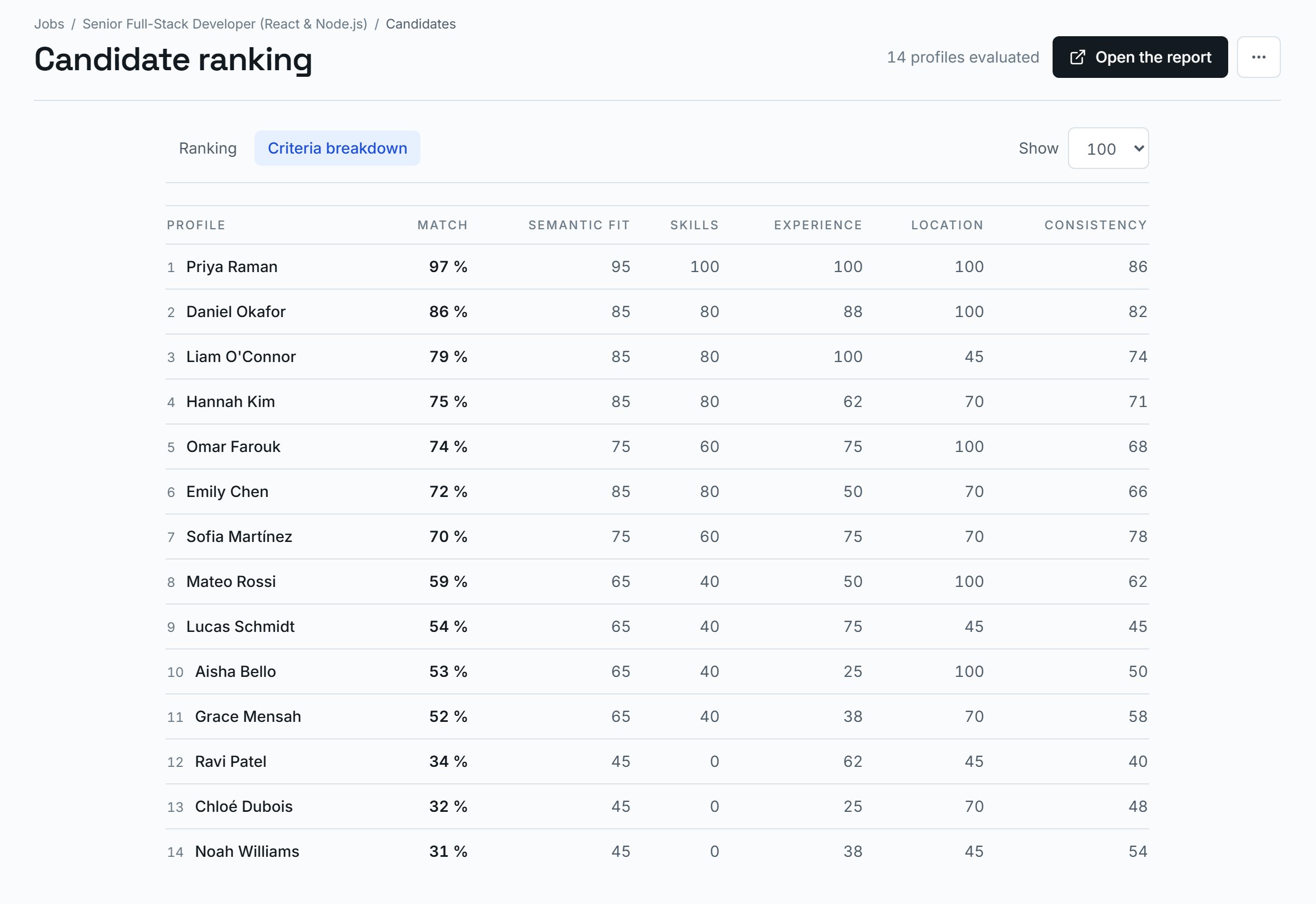
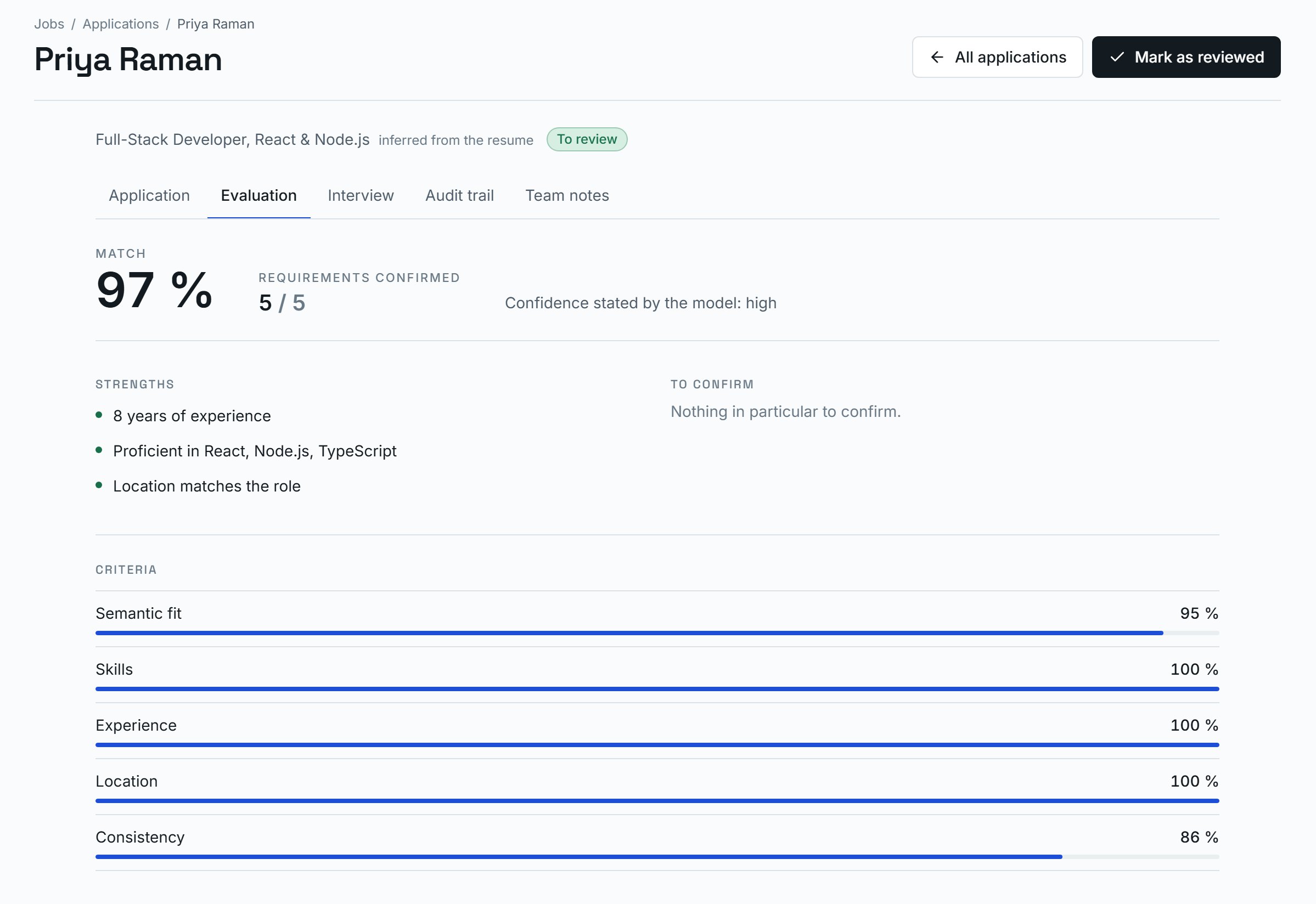
The match score is a weighted sum computed in code. Four of the five criteria are deterministic: the same CV against the same job always gets the same result. A language model contributes one criterion, worth 10%.
| Criterion | Weight | How it is measured |
|---|---|---|
| Skills | 30% | Share of the job’s required skills that the CV actually mentions. |
| Semantic fit | 25% | Similarity between the CV and the job posting, from an embedding model that runs inside Nexus, not through an outside service. |
| Experience | 20% | Years of experience against the job’s minimum, capped by what the CV’s own dates support. |
| Location | 15% | Whether the candidate’s region matches the job location. An unknown location scores as neutral. |
| Consistency | 10% | A language model reviews the anonymized profile for consistency with the role. This is the only criterion it scores. |
Weights are fixed and the same for every candidate. The model that reviews the profile never sees a name, photo or contact detail.
Bias testing, with the numbers
Two CVs of identical merit, differing by a single attribute, are scored against the same job. The gap between their scores must stay within 3 points out of 100. The limit is set before anything is measured.
| What differs between the two CVs | Largest gap |
|---|---|
| Gender, origin suggested by the name, age, place of residence | 1 point |
| Language the CV is written in (English or French) | 2 points |
We also score the same CV eight times in a row. The standard deviation was 0.43 points for strong profiles and 0.86 for average ones, against a limit of 2.
Measured on October 22, 2026, with real model calls and synthetic profiles. Every change to the scoring is also tested automatically before release. These tests show the scoring treats these attributes neutrally. They are not an adverse impact analysis on real applicants, and not an independent audit. The full reports are available on request.
What Nexus does not do
- It does not reject candidates. It drafts rejection emails for a recruiter to approve, and sends none of them itself.
- It does not see who the candidate is when scoring. Names, photos and contact details are kept out of every evaluation.
- It does not analyze video, voice, faces or personality. Only the CV and the application form.
- It does not look candidates up online. No social networks, no data brokers.
A record of every step
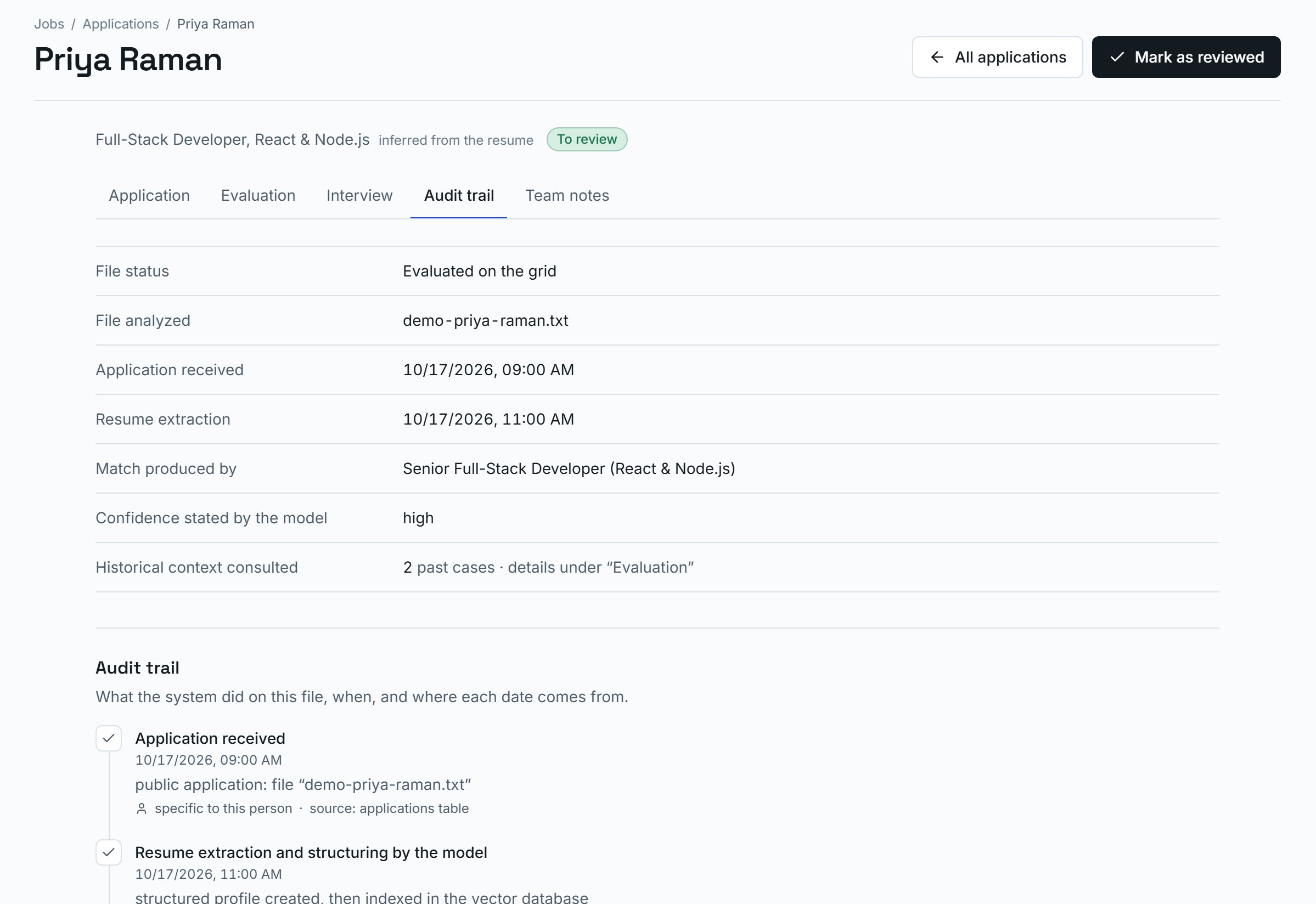
Who opened an application, when, what was decided, and which model produced each automated step. The log can be exported for an audit. Candidates can have their data erased on request, and you set how long applications are kept.
Application data is stored in the European Union, in Frankfurt. CV files are encrypted.
Start with a pilot
Eight to twelve weeks, on one or two of your open roles, on an instance dedicated to your organization. We agree on the measures before we start: hours spent screening, the share of Nexus finalists your recruiters choose to interview, and their feedback at the end. You decide what happens next based on those results.
To see it first, book a demo or write to contact@zeloqra.com.